Climate Science in One Page
What would 4˚C warming mean?
According to the UK Committee on Climate Change, October 2008
“The Committee’s judgement, on the basis of the IPCC AR4 report, is that … if a 4°C rise were reached, extreme consequences potentially beyond our ability to adapt would arise. We therefore believe that global policy … should ensure that the probability of crossing the extreme danger threshold of 4°C is reduced to an extremely low level (e.g. less than 1%).”
According to Professor Kevin Anderson, Tyndall Centre:
“there is a widespread view that 4°C is:
- incompatible with an organised global community
- beyond ‘adaptation’
- devastating to eco-systems
- highly unlikely to be stable (tipping points, etc.)
and consequently, 4°C should be avoided at ‘all’ costs.”
According to Professor Jonas Rockstrom, as set out in his interview with the Guardian in May 2019:
“Indeed, the consequences of a 4C warmer world are so terrifying that most scientists would rather not contemplate them, let alone work out a survival strategy.
Rockström doesn’t like our chances. “It’s difficult to see how we could accommodate eight billion people or even half of that,” he says. “There will be a rich minority of people who survive with modern lifestyles, no doubt, but it will be a turbulent, conflict-ridden world.””
What’s the probability of crossing 4˚C?
According to Sir David King, the Government’s former Chief Scientist:
“A temperature rise of 4.0 degrees C would give rise to unmanageable risks, and yet this is the most likely outcome by 2100 unless appropriate global action is taken.”
According to last full IPCC report, AR5, from 2014:
“In most scenarios without additional mitigation efforts … warming is more likely than not to exceed 4 degrees C above pre-industrial levels by 2100.” [Summary for Policy Makers, s.3.2, p.18]
“Estimates of warming in 2100 without additional climate mitigation efforts are from 3.7°C to 4.8°C compared with pre-industrial levels (median climate response); the range is 2.5°C to 7.8°C when using the 5th to 95th percentile range of the median climate response.” [Synthesis Report, 3.2, p. 77]
What’s required for compliance with the Paris Agreement?
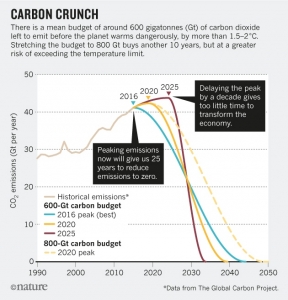
If global emissions start rapidly falling in 2020, the world will have twenty years to decarbonise. But if action is delayed until 2025, that period will reduce to ten.
See https://www.nature.com/news/three-years-to-safeguard-our-climate-1.22201